Spring flowers: Senecio lautus, a native daisy
1 Comment »31st August, 2017; Category: General, Daisies, Drought Tolerant Plants, Frost Hardy Plants, Hardy Australian Native PLants, Plant species, Plants of South Australia
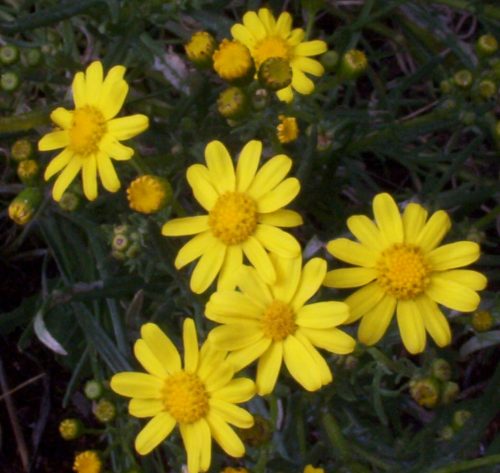
Native daisy Senecio lautus flowering in our small piece of scrub.
Why are you growing weeds? I was a bit taken a back because as far as I knew Senecio lautus was an Australian Native daisy. So what is a definition of a weed?
My understanding is that weeds:
- are introduced species from another continent, usually brought in by people knowingly or unknowingly eg. in the padding in saddles in the ‘olden days’.
- are introduced species which have become escapees from garden environments eg. watsonias and Acacia baileyana in the Adelaide Hills
- native species planted for a specific purpose which have escaped that particular environment
- native species which seed all over the place and take over garden beds. Some people don’t mind this but to others it is a nuisance and the plant is therefore a weed.
Senecio lautus may come into the latter category, but I don’t mind at all. Bring it on, I say. They flower among the mallee trees on our block, come up in pots where I don’t want them, flower prolifically along the South Eastern Freeway on the way to Adelaide and give a glorious glow of warmth on cold cloudy days.
They are easily pulled out if not wanted in a specific location. Some appear to be perennial up to 60-70cm tall, others flower at about 30cm, some require cutting back after flowering to maintain a neat bush. Many just appear to die back and re-shoot when it rains in early winter. I consider them worth having, but of course once you have one seed in the garden you are likely to have them next season whether you want them or not! Find out more about Senecio lautus.
I picked some yesterday morning in an experiment to see if they would last as a cut flower. I hadn’t bothered to try before. I will report back. One thing I did notice is that some flowers closed their petals last night.
Spring Flowering Plants
No Comments »31st August, 2017; Category: Daisies, Frost Hardy Plants, General, Plant species, Plants for Shade, Plants of South Australia
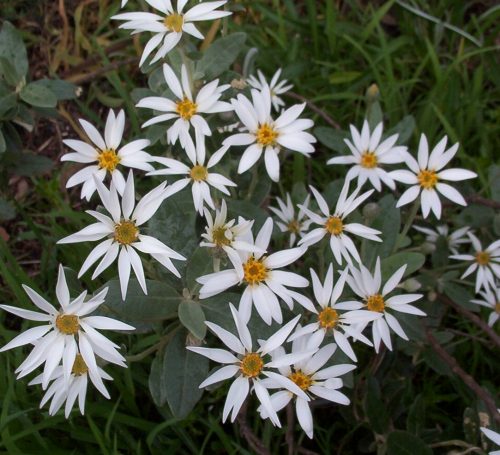
Olearia pannosa beginning to flower in my garden
When I look at the date on the last post made on this blog I am horrified but that is how life is sometimes. I have had to desist growing the large numbers of plants I used to but I cannot resist plants that have cuttings on them so I am always having a go at something, just not on the scale I would like to do.
A friend asked me for photos of a couple of South Australian native plants and that set me thinking about what I might be able to do on the blog. There are a number of posts that need tidying where links have been broken over the years, and probably better photos in my collection now. Spring is a great time to be stimulated to share the wonder of our amazing native plants as many begin to burst into flower in the next few months.
For further information Olearia pannosa.
What’s flowering in May?
No Comments »25th May, 2015; Category: Climbers and Ground Covers, Drought Tolerant Plants, General, Plant species, Plants of South Australia
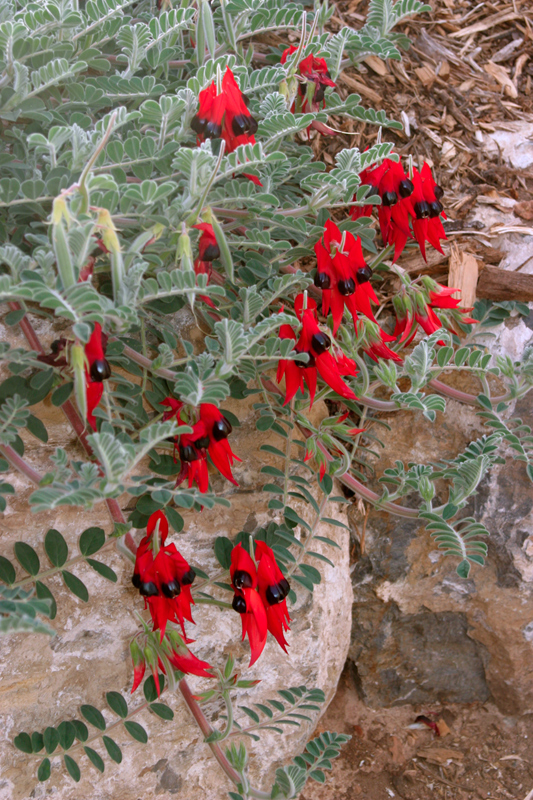
Photo by M Tranent. I hope to upload a photo of the garden mentioned.
There are quite a few plants flowering in my district in May. They include Swainsona formosa, Acacia iteaphylla, Eremophila maculata forms, to name a few. This has stimulated me to begin again on my blog, as well as the queries for information that I periodically receive. My lifestyle has changed and should allow me to pick up again.
Swainsona formosa may seem to be an unlikely plant to include in this list. However a roughly 5square metres front yard of a house in the town has been sown completely to the Sturt’s Desert Pea. The owner described to me that he threw a handful of seed over the yellow gravel he had spread over the area which may have been lawn before. He did it at this time of the year relying on natural rainfall to germinate the seed. He applied some extra water during the height of summer to keep them going. The result was a gorgeous display of red flowers with the black eye, against the grey green foliage. He showed me where more seed was germinating in some of the bare patches. He also had an abundance of seed pods filled with seed, a handful of which he generously gave to me.
Olearia passerinoides
No Comments »26th February, 2009; Category: Daisies, Drought Tolerant Plants, Hardy Australian Native PLants, Plants of South Australia
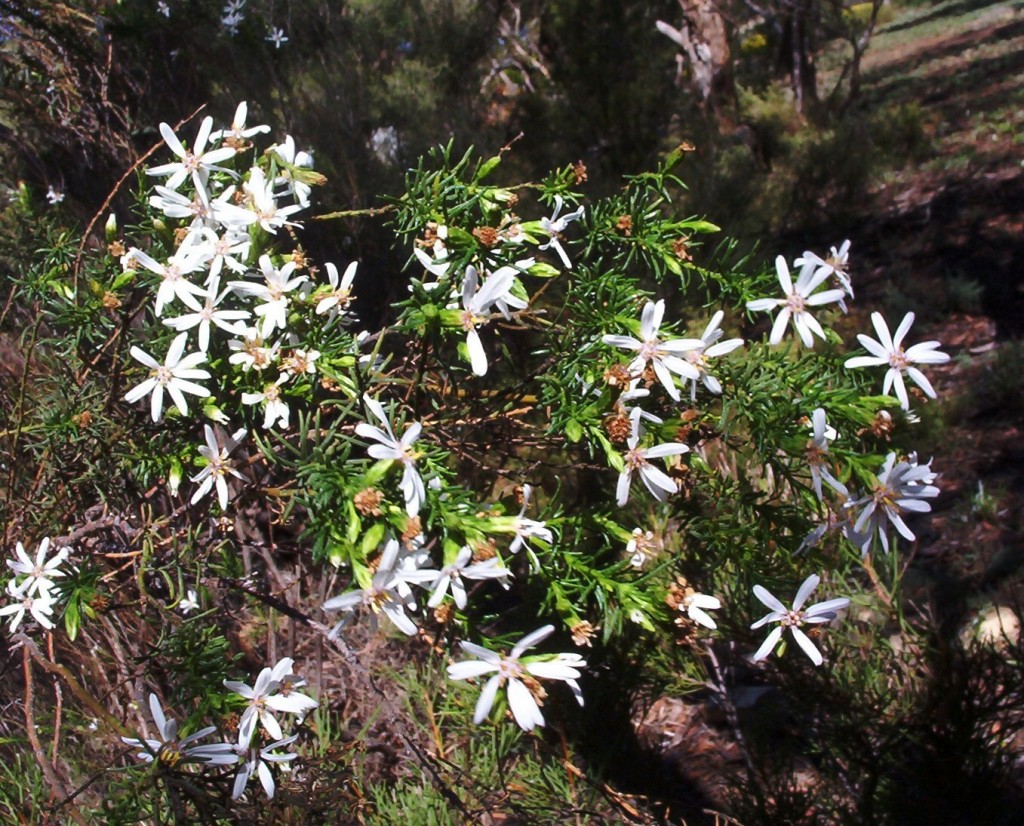
Olearia passerinoides (Daisy Bush)
Olearia passerinoides is a mallee daisy and is quite a large bush with bright green leaves, different to many mallee daisies which often have grey green leaves. Although this is a shrub, to me it behaves as a perennial shrub, in that new growth appears along the older wood.
The bush has a tendency to become scruffy, with the leaves higher up the stems and the flowers also high. If it was cut back to the lower growths, it would have dense foliage and be a more compact plant, and I suspect the flowering would also be quite spectacular.
As usual, I promise myself that I will do this, and yet another season goes buy. Mine have just finished flowering, so out with the secateurs tomorrow, while I think of it.
Olearia passerinoides is drought, lime and frost tolerant. It has clusters of small white daisies and grows to 2-3m tall by about 1.5-2m wide if left to its own devices. Pruning will keep it to a more compact size.
Templetonia retusa (Cocky’s Tongue)
8 Comments »1st January, 2009; Category: Drought Tolerant Plants, Hardy Australian Native PLants, Plants of South Australia, Using Australian Natives

Templetonia Retusa
There are large, red pea shaped flowers very attractive to birds and butterflies, during winter and spring. This is a hardy plant suitable for front line coast and inland situations. It is moderately frost tolerant and requires good drainage. This can be achieved by creating a planting mound at least 5-10cm higher than the surrounding soil, if drainage is a problem. Templetonia retusa is found in South Australia and Western Australia. More information can be found here and here.