Acacia baileyana prostrate form (Cootamundra Wattle)
17 Comments »28th January, 2009; Category: Acacia, Climbers and Ground Covers, Hardy Australian Native PLants
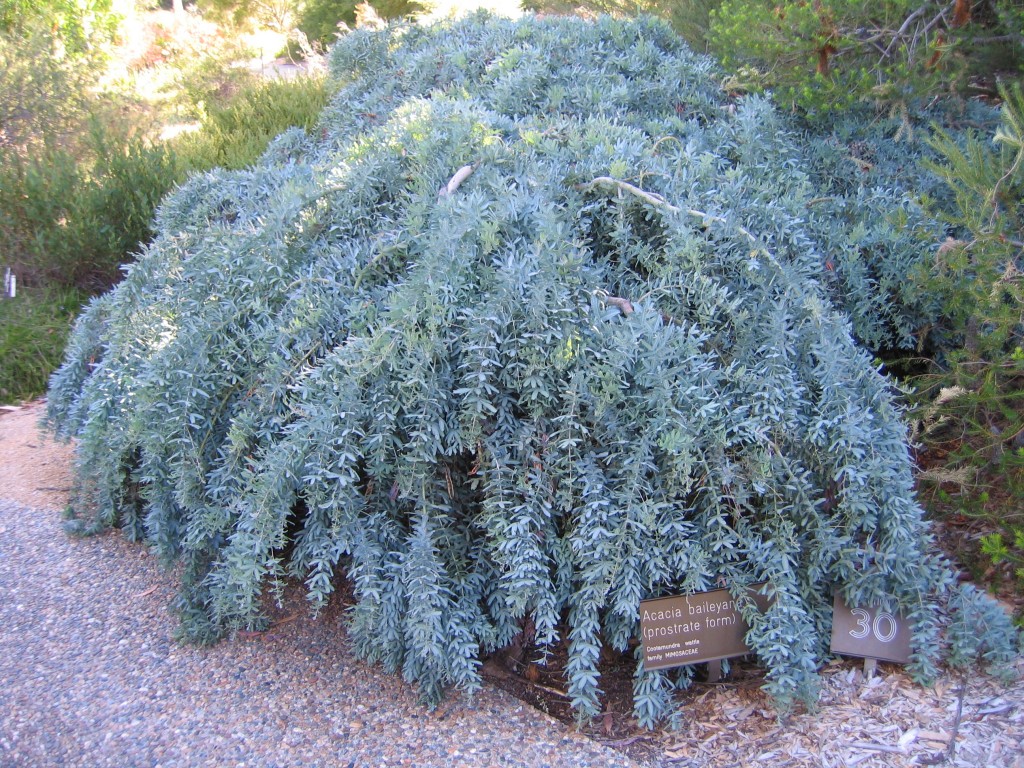
Acacia baileyana prostrate form (Cootamundra Wattle)
The prostrate form of Acacia baileyana is a lovely form of the taller tree. Even without flowers, the dense, grey green foliage is attractive in a garden setting. It cascades over slopes and follows the contour of the ground and it is excellent for covering large areas as a ground cover as it grows 30-60 cm tall and 3-4 metres wide. It has bright yellow flowers from winter to spring. It is a very hardy plant in most situations, withstanding dry periods and growing in full sun to part shade in sand, clay or loam.
A photo of the larger form in flower can be seen here.
I would like to know where or how i could get a acacia baileyana prostrate form Cootamundra wattle
Live in suburban Sydney Australia and would to know if this plant survives in this area and where can I purchase plant.
Thank you
This should grow in Sydney. Native plant nurseries or your local nursery and ask if they can get it in. The upright form is from the area around Young.
I have what I think is a Cootamundra Wattle, prostrate – or at least sem-prostrate (if there is such a plant). The plant, as I understand ‘prostrate’ is not ground cover, nor is it as low as it appears in many of the images I’ve viewed.
There is a distinct trunk, about 100mm diameter, up to about 600mm mm high, with branches in all directions.
Its foliage I find difficult to describe – I’m not a gardener at all – but it is ‘bluish’ and carries the ‘usual’ wattle flowers in late winter into spring.
It seems a vigorous, hardy plant and has survived some pretty heavy frosts in Kenthurst, NSW. Some have mentioned that it may be a ‘grafted’ variety.
Its canopy ‘spread’ is about 2.5m in diameter and overall height is around 1m. It’s growing in pretty rich soil, which I brought in. As I understand soil, it’s not’native’ stuff.
It is pruned a couple of times each year, to keep its shape and to eliminate the ‘drooping’ fronds, which tend to get a bit woody and inhibit trimming. It’s in an elevated, brick. garden bed, about 300mm above surrounding ground level.
I’d like to source about ten more small plants of the same variety: could you advise where, in Sydney, these may be available?
Thank you
Warwick Cuneo
I have a prostrate wattle and have noticed small white seed-like balls on the branches. They are soft and when squeezed, a greenish sticky liquid comes out. does anyone know what these little white things are please? Thank you.
It sounds like mealy bug. If you can try to squash them by hand. Use an approprite treatment against sucking insects if the infestation warrants it. Should you see any ants on the bush deal with them as well. I believe there are some sticky ‘glues’ that can be painted around the stem. A little more difficult if the plant is touching the ground an many places.
Have been growing this prostrate wattle for 3 years on west facing foothills of Adelaide. It is slow growing but tough as old boots – takes heat, drought, winter cold and damp and the rabbits avoid it! Only complaint is that as a cultivar, it was expensive. Will be planting more on exposed sites that normally tax other ground creepers like correas and grevillias.
Am a qualified horticulturist that just adores this plant. I have been trying to source this Acacia through a lot of nurseries, only to be informed that it is no longer available. If anyone is successful, would you mind letting me know. Thanks.
My prostrate cootamundra wattle is about 1.5 mt high and about 4 mt wide its now 25years old. I wonder if you can prune them from the top of the foliage to reduce its height. It is an amazing feature shrub but just getting to high.
Hi Bernadette, yes you can prune it from the top……I have done it with no issues to the plant. Penny
Sorry Penny – have just seen your commment from 2016 – we purchased a prostrate acacia baileyana from the Heritage Nursery in Canberra two years ago. I’m looking for anyone who can give us a clue as to why it is now losing its foliage at quite a rate! No sign of leaf drop so could it be something devouring them? No sign of mealy bug infestation, no sign of snail trails – any info would be welcome.
Hi Patricia, I’ve managed to purchase a few of these superb plants. I have them in a dappled northern aspect and give them none to minimal water. What is the aspect of your Acacia’s and do you water at all? Penny.
Hi
I’m just wondering if you still sell Acacia baileyana prostrate and if so –
Do you send them?
What size?
What price?
Look forward to hearing from you.
Cheers
Ona Winter-Irving
Hi there Ona,
I am sorry but the nursery is now closed with no plants for sale. It was my wife’s nursery and she passed away early last year.
Oh I’m so sorry to hear that – I hope you are coping, I understand how difficult grief is.
Thank you for replying.
Best wishes
Do you have any for sale?
Hi Bronwyn
Sorry for the delay in replying; I have been in hospital for 5 weeks. Mallee Native Plants Nursery was run by my wife until her passing nearly five years ago. It is now closed with no plants for sale. I keep the website going because it contains much useful information.
Trevor