Carpobrotus rossii (Pig Face) In Flower
58 Comments »26th October, 2006; Category: Bush Tucker, Climbers and Ground Covers, Drought Tolerant Plants
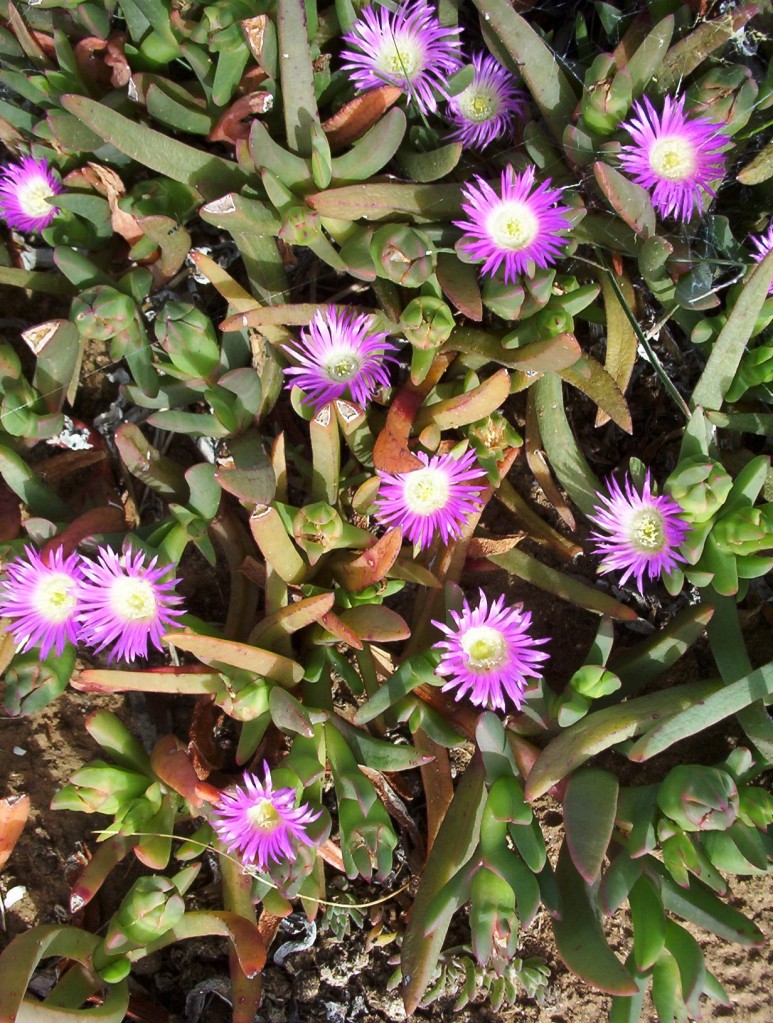
Carpobrotus rossii (Pig Face)
This is the flower of the succulent plant in the previous post. There were only a few isolated flowers on the plants near the nest. This is a useful plant. Not only is it useful and decorative in the garden, it is one of the bush tucker plants used by the local Aboriginal group. The leaves and fruits were used as a kind of relish to be eaten with meat. The juice from the leaves is also said to be an insect repellant. As with any new thing, a cautious test should be done before slathering one’s skin with the juice of an unknown plant.
I guess the same could be said for the plants in the Aloe family. Aloe Vera is good on a number of skin ailments but I am never sure which member of the species is the one to use.
This image looks upside down to me…
I took the photo looking directly down on the plant which was growing on flat ground.
I have noticed that my poultry love eating my orange flowered pigface plant, are you able to tell me if this is harmful for them or medicinal? I think by now it must not be poisionous for them, since this has been going on for a few months & there health is fine. recards Carmz
Sleepy lizards eat the flowers on the native pig faces, all in the same family of plants, and I am sure they do no harm. The leaves and fruits of the native pigfaces used to be made into a relish by Aboriginal people.
I replanted some cuttings of a pigface and although the plant has thrived it does not flower.
What is wrong?
Pigface are in general winter to spring flowering. If your plant is growing too vigorously, it will not flower well. Do not use too much fertiliser and make sure you have very good drainage. Also do not water constantly.
My pigface plant is now spotted in white goo and is just about dead. I live in the Sutherland Shire NSW and the plant was doing well and this has happened within the last three months. What have I done wrong and how can I avoid this in the future?
Many blessings, Venerable Yangchen
The white goo is woolly aphids or mealy bug. If you can squash the insects, do so. If there are too many, there is a spray you can use. Check at a plant nursery.
I live in Wamboin just outside Canberra near Bungendore. How does frost affect pigface? What advice can you give for its protection in the cold months if that is needed?
We have frost here, but not as severe as Canberra. If protection is needed, try a light covering with straw, or when frost is predicted, something like an old curtain or sheet.
Hi we have big Whits patches among our pigface what causes this please last year we pull a lot of it out and thought it was gone now it has started again on the remaining plants what can we do thank you for your time regards sandra
I don’t water my pig face at all, it is growing vigorously & it has never flowered in over 12 months. How can i get it to flower?
Is it growing in a sunny open position? They need this. Also remember that they are winter- spring flowering.
Will pig face be toxic to dolphins?
I don’t know. It is not toxic to land animals.
I was given a small cutting of the shimmering pink pigface plant. I simply stuck it in soil and left it. It gets water once a month (no joking) and it is huge and full of blooms. I took a cutting from that one and did the same. I am now the proud owner (haha) of two gorgeous pig face plants.
These are very easy plants to propagate as you have found! Congratulations. In fact they can be propagated from quite small pieces. As you say, they are very drought tolerant. Some moisture will keep them spreading as I have discovered with mine this year as a result of last summers rains and better than average autumn rains. The plants in our scrub look wonderful this year.
Are you meant to remove the pig face flower once it has died??? And can u prune it back hard once it stops flowering
Removing the spent flowers keeps the plant tidy. However if you want to collect seed you need to let some of the larger fruit continue to ripen. Pruning all natives after flowering is a good idea. Don’t go back to bare wood. Always keep leaves on the stems. Some species will sprout from bare wood, others don’t like it.
My pig face had been growing beautifully with flowers and spreading well in our sunny rock garden for the past 12months but suddenly has started to go yellow and dry out over the past 4 weeks. I live in the ACT and not sure if it’s because of the cold snap we’re starting to have. Please help 🙂
Hi Bridget,
Pigfaces do eventually get dry patches near the centre of the plant, and this is when you might need to take some cuttings and replant (just cut off a ‘set’ of leaves and poke the stem into a place in the garden, or into pot of mix). Otherwise check that you don’t have mealy bug (white fluffy insect that can be squashed). If too many you might need to spray with confidor or other–check at a nursery.) Also make sure the ground is not soggy, or has become non wetting. We used to say if it grows in Canberra it will grow here. We haven’t had any frost yet, but these are quite frost hardy.
best wishes
I have pigface on my south facing balcony. It flowered very well throughout the summer but in three of the 4 pots it’s died back. Only one pot retained it’s leaves. I pruned them all back and found the ones I thought had died have living stems at the heart of the plant. I left these. Is there hope for them, please?
Thank you,
Fiona
Living stems are good! If your balcony gets rain on the plants, move the pots to where this will be minimal as pigface do not like to be soaked all the time. I’m sure they will grow on again for you. Even though you will be coming into summer, too much rain will be the problem, unlike here where rain diminishes markedly in the summer. I have to watch my pots as we have had 36mm in a week and the pots are very wet. Thankfully the potting mix is well drained.
My pigface have finished flowering is it now time to cut the dead tips off the plant?
Tidy the plant now.
I live in Tasmania when can I move my Pig Face Plants to a deeper planter and can I cut them back and take cuttings
Thanks
I too am seeking advice re: flowering. As read above I may be over watering as my plants are growing healthily and spreading quickly. However I have had no flowers in last 15 months. The garden bed gets around 2-4 hours direct sun only. Does this plant need more than that? I don’t have any beds with more time of direct sun but desperately hoping to see this gorgeous flower in my garden. Any further advice?
Hi Cathy,
These plants need a lot more light than you are giving them. Having said that, I notice that some of the pig face on our block grow where there is some dappled shade for part of the day. They do not need heaps of water.
Hi ,I have ,what I now know as a Pigface growing in a raised bed on my patio.I live in Southampton ,Southern England and put this plant in last year as a ground cover and it has taken off but has never flowered,is it likely to.It gets plenty of sun,regards Kerry.
They generally flower in late winter spring here (Temp about 15C onwards). You may be treating it too kindly. They do not need fertiliser unless you are in the very poorest soil, also too much water. They need plenty of sunlight.
I have a small 20 cm diameter terracotta pot, which is growing 2-3 plants of pig face, all grown from cuttings. I have had them for about 2 years and they haven’t flowered. I was living in an apartment with a balcony that never got any direct sunlight, but now I have moved, they can be in full sun.
How do I get them to flower? Should I re-pot them with a new succulent mix? Should I break them up, in case there is some over crowding going on?
From memory the flower colours should be, white, pink and red…
Repot the lot into a much larger pot of succulent mix. The weight of the pot and mix will prevent the pot from tipping over as the succulents grow.
I cut back my pig face which was growing onto our driveway but it died back after cutting. Is there a optimum time of the year to cut back pig face or should it not be pruned?
Pigface seem to die back in the hot weather. Don’t cut back to no leaves.
Hi Ladies, we live just outside of the ACT and want to grow pigface on our nature strip. Since we have a computerised watering system and get long periods of hot weather we thought it kinder to give our pig face some water. Are we better off putting a dripper to the base of the plant or spraying over the top of the (hopefully soon to be) spreading plants. We do not water every day and give them 5 minutes twice a day.
A dripper at the base is best. Later if you find the plants taking root along the runners you might like to add an extra dripper if the weather is dry. I note that Canberra has less rain than Adelaide which surprised me. There are plants in the ANBG which I admired and dismissed because of our very low rainfall, east of Adelaide.
Hi there,
I have a Pig Face plant that seems to be spreading okay, but the main stems are quite dry. The leaves are often plump, but often go deep red. When I try and snap the stem, it still has a green part on the inside, the outside just looks dry.
I think I might be over watering it. Does this sounds like symptoms of that?
I have tried cutting parts off and putting in other pots but it doesn’t seem to help.
Any ideas?
Thanks
I have moved into a new house with a 3 tiered landscaped garden. The bottom tier is mostly covered in 4 different colours of pigface. When I moved in it was flowering beautifully but now the flowers have died and it is overhanging. It looks quite ratty. There is a tree on my median strip which robs a couple of the plants of sun. After reading the above posts I would like to take a few cuttings for hanging pots. My question is should I trim the cascading leaves back. I have not ever watered these plants and the previous owners took care to mulch well in good soil. Thanks for your help.
I would cut back the plants, using the leafy joints as your new cutting material. Try not to go back to where there are no leaves.
My pig face are growing but I’ve only had one flower ….they are on a west facing balcony and get sun all afternoon …I don’t over water them but there are no signs of flowers .. there is no better spot for them to get more sun ….is this enough or will they never flower ?
I did put them in a larger pot only a couple of months ago ….could this be why they aren’t flowering ?
I was wondering if anyone can help me out I was wondering how long they take before the start to spreed please
Hi,
My pig face plants were beautiful.
Last week I noticed that some of my plants were looking like they were dying.
All the leaves at the base of the plant are black dying and my plant is looking unhealthy.
There are some white dots on the leaves all over the plant.
It looks like all my pig face plants are getting white dots on them.
Did I overwater my plants or is it an illness?
Thanks for your help
It sounds like woolly aphids. You can squash the insects, or dab some methylated spirits on each one using a cotton bud. Check for ant trails as they can be responsible for the increased numbers.
Hi Corinne 🙂
I am french and l would like to grow this in my sandy soil garden, but my issue is that cousin C. edulis or acinaciformis are not totally frost hardy :/ Does Carpobrotus rossii is more cold hardy than the others ? (We can have -10C° sometimes )
Thanks
I took a cutting from my daughter who lives by the beach in Sydney. Hers flowers well. I have had this for about 5 years. It has never flowered. I am ready to send it to pigface heaven. It gets a lot of sun and I don’t water it much. It is a big plant and looks very healthy. Any clues?
My pigface buds have been eaten by something. How do I prevent this from happening in the future and for the rest of the buds.
Hi Ulla Langstedt ,
This is the flower of the succulent plant in the previous post. There were only a few isolated flowers on the plants near the nest. This is a useful plant. Not only is it useful and decorative in the garden, it is one of the bush tucker plants used by the local Aboriginal group. The leaves and fruits were used as a kind of relish to be eaten with meat. The juice from the leaves is also said to be an insect repe llant. As with any new thing, a cautious test should be done before slathering one’s skin with the juice of an unknown plant.
I am french and l would like to grow this in my sandy soil garden, but my issue is that cousin C. edulis or acinaciformis are not totally frost hardy :/ Does Carpobrotus rossii is more cold hardy than the others ? (We can have -10C° sometimes )
Thanks
Here in South Australia, the plants survive frosts down to about -4 degrees.
I have large plantings of pigface. Each summer they die right back. I believe the plants are neither wet nor dry. Do pigface sunburn and can they ‘boil’. Our summer temps are regularly in the 40s. The plants go limp before dying off. Am desperate as I rely on them to cover large areas.
Hello, my pigface looks diseased. The edges of the leaves are going purple and brown spots are forming plus there are what looks like tiny popcorn pieces appearing in small clusters on some of the leaves. The “popcorn pieces” have a little brown cap and seem sort of powdery inside. The stems which are overhanging a wall are dying too. Can you help me? Thanks muchly.
Hi,I have a Pigface,about 1 metre by 1 metre, that I planted about 10 years ago, in a fall sun position, near the Coast. It’s only watered by rain.
It flowered really well until about 2 years ago. The bottom 20cm of the plant has turned black, then there’s about 30cm of green growth above looking okay.
What can I do to get it flowering again, or is it’s life over??
Hi, We have 4 new Orange pigface plants in the same area, they are not watered much. Three are doing fine and one has yellow leaves and doesn’t seem to be doing well. Is there anything I can do to fix this
What is the best way to prune this plant as mine is growing to aggressively over our footpath
Hi Ben,
They are very resilient and can be trimmed back using a spade. The chopped-off bits can be planted elsewhere but may take a while to settle in. We have some growing in amongst our mallee trees and they even get run over occasionally with our ride-on mower and they still thrive.
Thank you so much, so essentially I can cut them off at any point on the stem.
Not really planning on planting the off cuts but might give them away
We have pig face planted in our front garden as ground cover with light pink flowers. The ground cover was in full bloom a few weeks back but now there are many buds and still remaining flowers but the buds look like they are dead. As such when you look at the pink face now it is less green plant with pink flowers but more pink flowers amongst many brown buds. Have we done something wrong? We live in Melbourne with variable weather – we are having some warmer days of late. Have we over watered? Or over fertilised? Do we literally need to try to cut back all the brown buds or does nature take it’s course? HELP!!!
I planted two Pig Face plants about 12 months ago and they have grown so well and are spreading out beautifully but they have never flowered yet. I have put some seasole on them in hopes that will help. Does it take about 12 to 24 months for them to flower? I LOVE the gorgeous pink colour and so I am basically just praying they will flower one day. Is there anything else I can do to help them bloom?